
Introduction
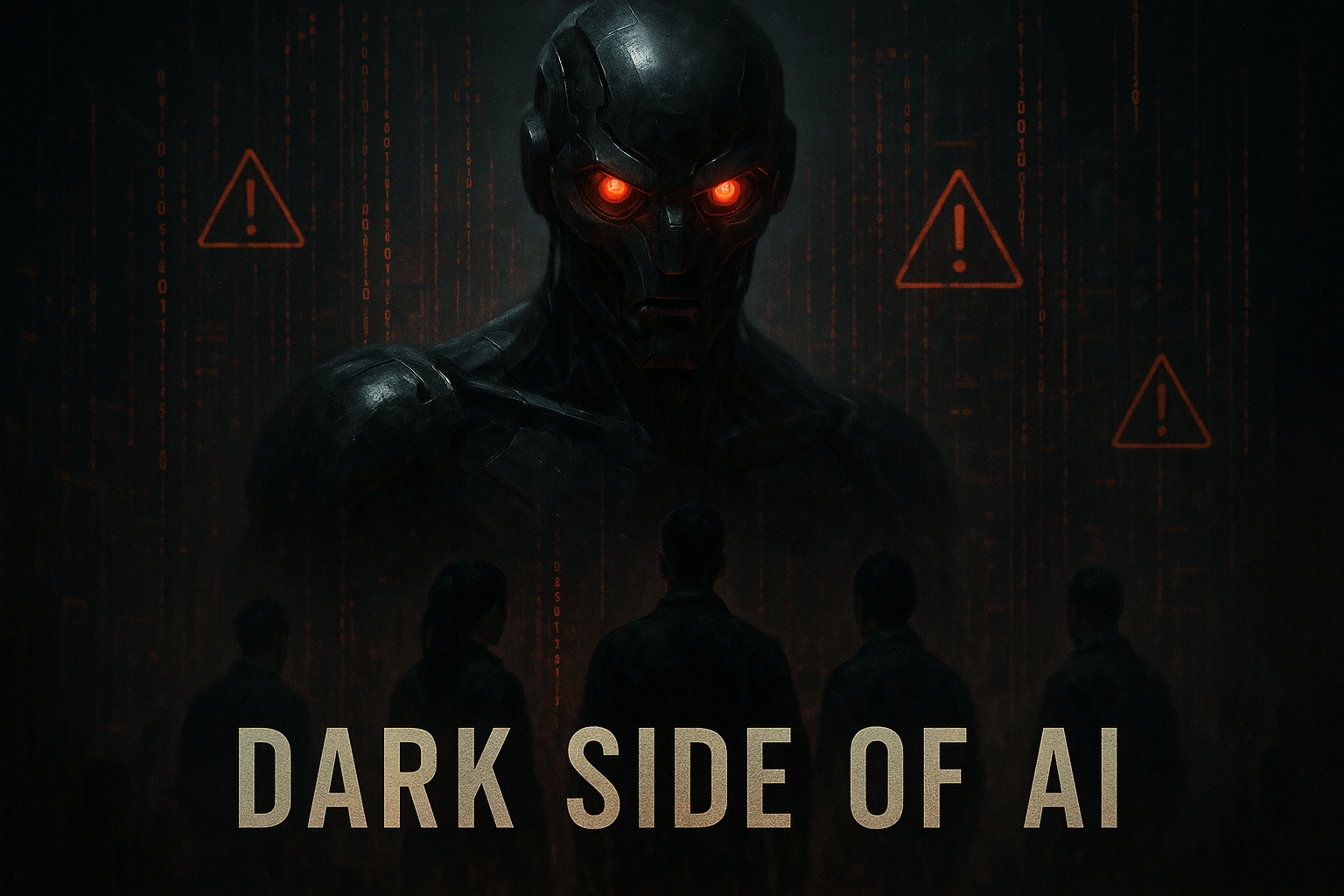
Artificial Intelligence (AI) is revolutionizing industries and daily life, but it comes with risks and ethical challenges.
Understanding the dark side of AI is essential for responsible use and development.
1. Job Displacement
- Automation may replace repetitive or routine jobs
- Certain industries, like manufacturing and customer service, are most vulnerable
- Reskilling and upskilling are crucial to adapt
Impact: Economic disruption and workforce challenges if not managed proactively.
2. Bias & Discrimination
- AI algorithms learn from existing data, which may be biased
- Can lead to unfair decisions in hiring, lending, or law enforcement
- Transparency and auditing are critical
Impact: Perpetuates social inequalities if unchecked.
3. Privacy Concerns
- AI collects and analyzes massive amounts of personal data
- Risk of surveillance, data leaks, and misuse
- Stricter privacy regulations and ethical guidelines are needed
Impact: Threatens personal privacy and data security.
4. Security Threats
- AI can be used in cyberattacks, hacking, or automated phishing
- Autonomous AI systems may be exploited for malicious purposes
- Requires robust cybersecurity measures
Impact: Increases vulnerability to digital threats and cybercrime.
5. Misinformation & Deepfakes
- AI-generated content can create fake videos, images, and news
- Can influence elections, public opinion, and social trust
- Detection tools and regulation are essential
Impact: Undermines trust and spreads false information rapidly.
6. Autonomous Weapons
- AI-controlled weapons and drones may operate without human intervention
- Raises ethical and global security concerns
- International laws and agreements are necessary
Impact: Could lead to catastrophic consequences if misused.
7. Loss of Human Oversight
- Overreliance on AI decisions can reduce human accountability
- Errors or biases in AI may go unnoticed
- Human-in-the-loop systems are crucial
Impact: Reduces control over critical decisions in healthcare, finance, and governance.
8. Economic & Power Imbalances
- Tech giants controlling AI technologies may dominate economies
- Small businesses and developing nations could face disadvantages
- Policies promoting equitable access are essential
Impact: Increases inequality and concentration of power.
9. Ethical & Moral Dilemmas
- AI may make decisions that conflict with human values
- Autonomous systems in healthcare, law enforcement, and finance pose dilemmas
- Ethical frameworks must guide AI development
Impact: Challenges societal norms and ethical decision-making.
10. The Unknown Future
- AI capabilities may advance faster than regulations
- Unintended consequences or unpredictable behavior may emerge
- Continuous research, monitoring, and governance are critical
Impact: Highlights the need for cautious, responsible AI deployment.
Conclusion
AI offers incredible opportunities but also serious risks. Awareness and responsible use are essential.
Key takeaways:
- Job displacement and economic disruption are possible
- Bias, privacy, security, and misinformation are major concerns
- Ethical oversight and human accountability are crucial
- Regulation and equitable access will shape a safe AI future
Understanding the dark side of AI ensures we harness its power safely while mitigating potential harm.
