

Introduction
Artificial Intelligence (AI) is rapidly reshaping the job market.
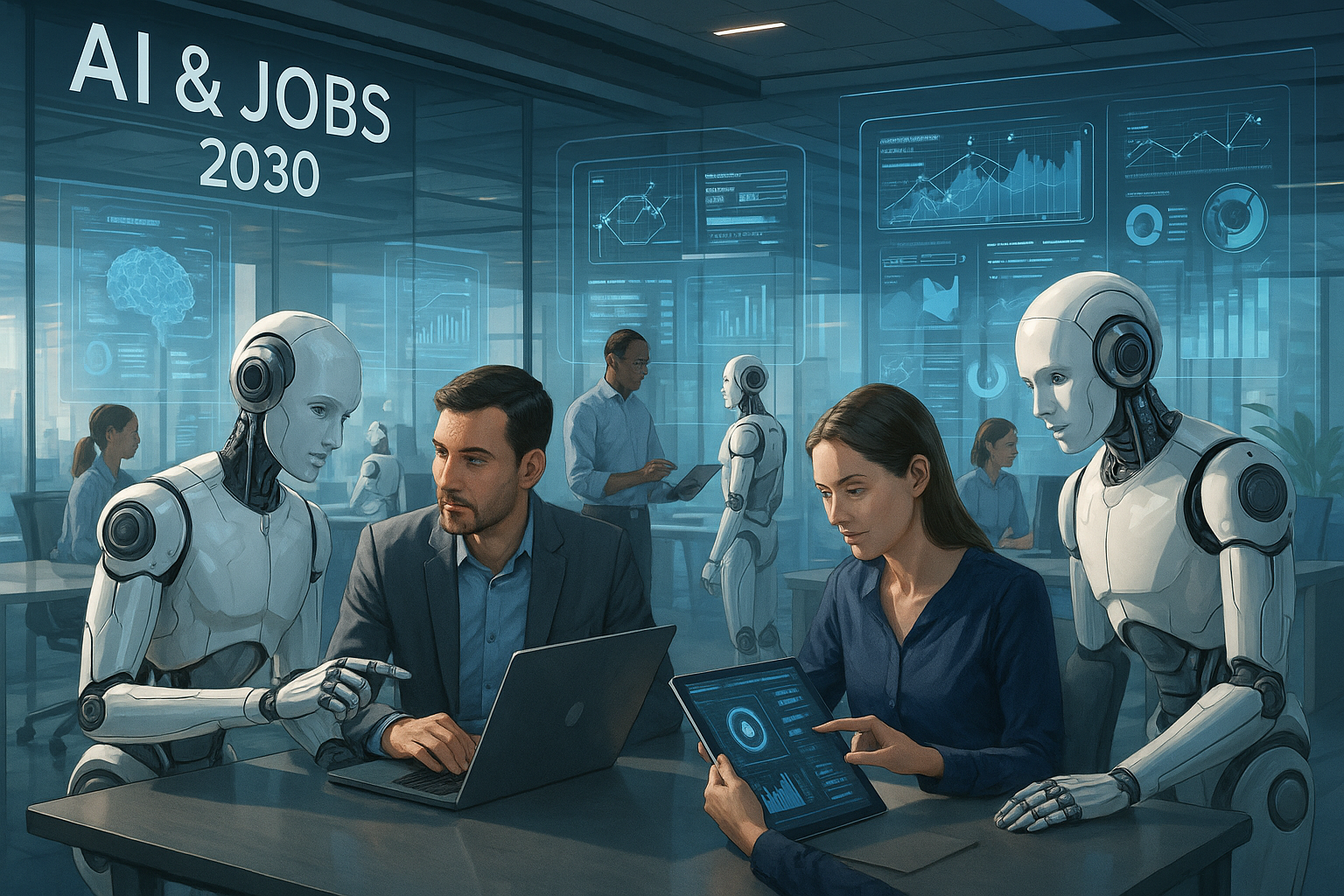
By 2030, AI is expected to change how we work, the types of jobs available, and the skills required.
This blog explores the ways AI will transform the workforce and how professionals can prepare.
1. Automation of Routine Tasks
- Repetitive administrative, clerical, and data-entry tasks will be automated
- AI-powered software can handle scheduling, invoicing, and reporting
- Employees can focus on creative, strategic, and analytical work
Impact: Increased productivity, reduced human error, and more meaningful job roles.
2. Emergence of New Job Roles
- AI specialists, data analysts, robotics engineers, and machine learning experts
- Jobs in AI ethics, AI auditing, and human-AI collaboration
- Roles in emerging industries like autonomous vehicles, smart cities, and AI healthcare
Impact: New career opportunities requiring specialized skills and education.
3. Enhanced Decision-Making
- AI analyzes large datasets to provide actionable insights
- Supports decision-making in finance, healthcare, marketing, and logistics
- Enables faster, more accurate, and data-driven strategies
Impact: Human jobs will focus on interpretation, strategy, and oversight rather than data processing.
4. Remote Work & AI Collaboration
- AI-powered tools enhance productivity and communication for remote teams
- Virtual assistants, scheduling bots, and collaborative AI platforms streamline work
- Teams can focus on creative problem-solving and innovation
Impact: The nature of work shifts toward collaboration with AI as a partner.
5. Personalized Employee Training
- AI identifies skills gaps and recommends personalized learning paths
- Adaptive learning platforms for upskilling and reskilling
- Continuous professional development becomes automated and efficient
Impact: Workers can stay competitive in rapidly evolving industries.
6. Changes in Manufacturing & Logistics
- AI-driven robots and autonomous machines handle production, warehousing, and delivery
- Predictive maintenance and supply chain optimization
- Human roles focus on oversight, problem-solving, and innovation
Impact: Reduced labor-intensive tasks and increased efficiency in manufacturing and logistics.
7. AI in Healthcare
- AI assists in diagnostics, treatment planning, and patient monitoring
- Roles in healthcare will evolve toward AI management, interpretation, and patient care
- Telemedicine and AI-driven health services will expand
Impact: Jobs in healthcare become more tech-oriented and patient-focused.
8. Creative Industries & AI
- AI-generated content, music, and design tools assist creative professionals
- Collaboration between humans and AI in art, writing, and marketing
- Human creativity remains essential for originality and emotional impact
Impact: Creative roles will evolve rather than disappear, enhancing human-AI synergy.
9. Job Displacement and Reskilling
- Certain repetitive jobs may become obsolete
- Reskilling and upskilling programs will be critical for workforce transition
- Governments and companies must invest in workforce adaptation strategies
Impact: Proactive learning ensures adaptability in the AI-driven economy.
10. Ethical & Regulatory Roles
- AI ethics officers, auditors, and compliance experts
- Policies and regulations to govern AI use in workplaces
- Roles ensuring fairness, accountability, and transparency in AI systems
Impact: Ethical oversight will create new professional opportunities.
Conclusion
By 2030, AI will transform jobs, create new roles, and redefine required skills.
Key takeaways:
- Routine tasks will be automated, increasing efficiency
- New jobs will emerge in AI, ethics, healthcare, and creative collaboration
- Continuous learning and reskilling are essential for workforce resilience
- Humans will focus on creativity, strategy, and decision-making alongside AI
Preparing for the AI-driven future ensures professionals remain relevant, adaptable, and competitive in the changing job landscape.
