

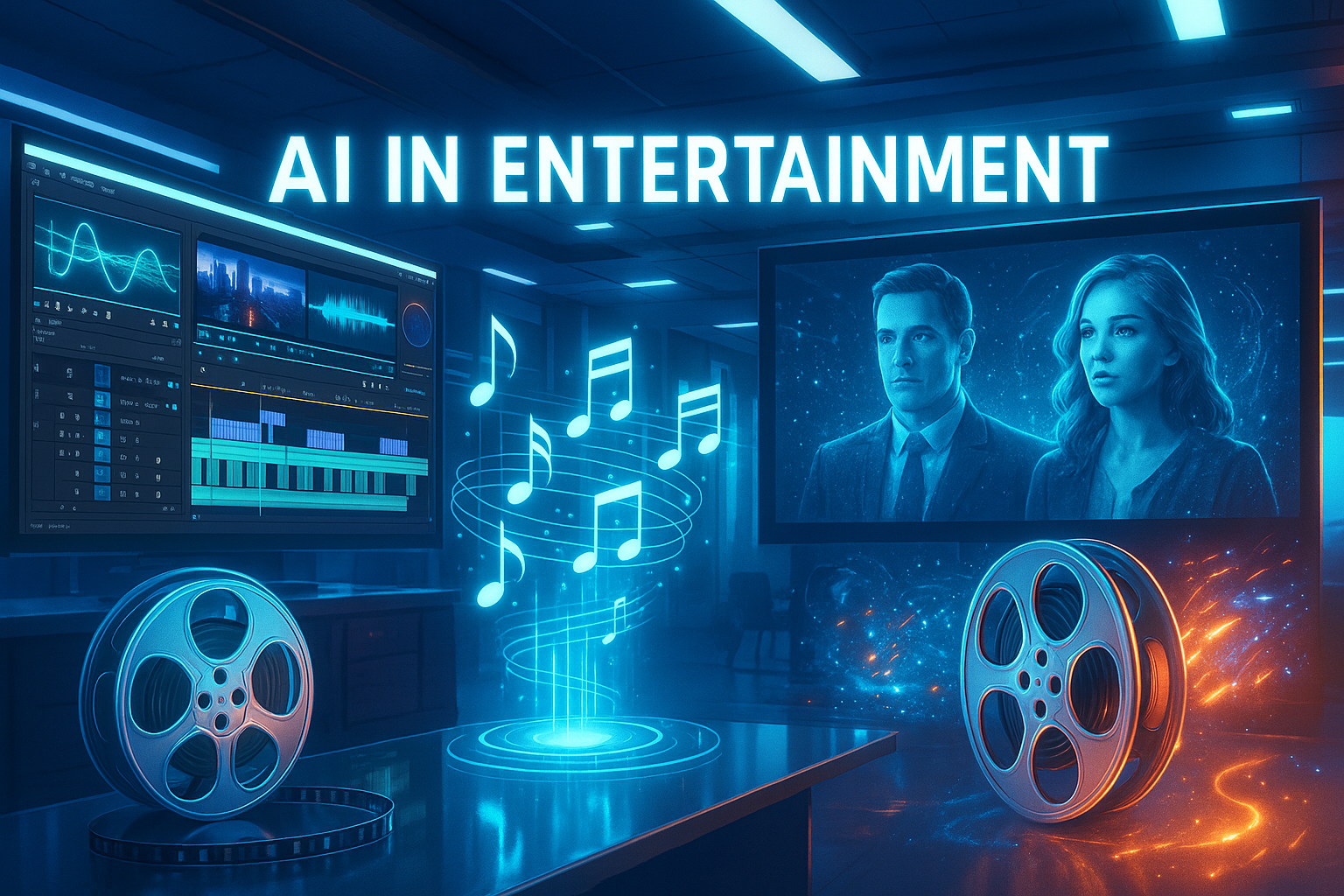
Introduction
Artificial Intelligence (AI) is no longer just a buzzword — it’s revolutionizing the entertainment industry.
From filmmaking to music production and content streaming, AI is changing how creators work and how audiences consume entertainment.
In this blog, we’ll explore how AI impacts movies, music, and the broader entertainment landscape.
1. AI in Filmmaking
AI is transforming the way movies are created.
Applications:
- Scriptwriting assistance: AI tools can generate story ideas, dialogue, and plot suggestions.
- Visual effects (VFX): AI speeds up CGI rendering and improves realism.
- Editing automation: AI can select the best shots, color correct, and even suggest cuts.
- Casting analysis: AI predicts which actors resonate with target audiences.
Impact: Faster production, lower costs, and more creativity.
2. AI in Animation
Animation studios are using AI to:
- Generate character movements automatically
- Animate facial expressions using motion capture
- Reduce manual drawing workload
AI accelerates production while keeping quality high, enabling studios to produce more content in less time.
3. AI in Music Production
AI tools are now composing, arranging, and even performing music.
Applications:
- AI-generated beats and melodies
- Auto-mixing and mastering tracks
- Lyric suggestions
- Voice synthesis
Impact: Independent artists and creators can produce professional-quality music without expensive studios.
4. AI in Video Editing & Post-Production
Editing is time-consuming, but AI automates:
- Cutting unnecessary footage
- Color grading
- Background noise removal
- Subtitles & translations
This speeds up post-production and allows creators to focus on storytelling.
5. AI for Personalized Streaming & Recommendations
Streaming platforms like Netflix, Spotify, and YouTube rely on AI algorithms to:
- Suggest movies, shows, or songs based on taste
- Predict trending content
- Improve user engagement
Impact: Audiences discover new content easily, increasing consumption and satisfaction.
6. AI in Marketing & Promotion
Studios and record labels now use AI to:
- Predict audience reactions
- Target social media ads
- Analyze engagement metrics
- Generate trailers and promo material
AI reduces marketing guesswork and increases revenue potential.
7. AI-Generated Content
From virtual influencers to fully AI-generated films, entertainment is entering a new era.
Examples:
- Virtual actors for movies & ads
- AI-written novels adapted to scripts
- AI-created music videos
- Deepfake technology for recreating famous performances
This opens creative possibilities previously impossible.
8. Ethical Considerations
While AI is transformative, it raises concerns:
- Job displacement in creative industries
- Copyright & intellectual property issues
- Deepfake misuse
- Creative authenticity debates
Balanced adoption is essential to maximize benefits.
9. Future Trends in AI Entertainment
- AI co-creators assisting directors & musicians
- Immersive experiences: VR + AI for interactive storytelling
- Smart content optimization based on real-time feedback
- Fully AI-produced movies & music tracks
The line between human and AI creativity will blur.
Conclusion
AI is no longer just a tool — it’s a creative partner in entertainment.
Movies, music, and digital content are becoming faster, smarter, and more personalized thanks to AI.
Key takeaways:
- AI speeds up production and post-production
- Helps independent creators produce professional work
- Enhances audience experience through personalization
- Opens new frontiers for creative storytelling
The entertainment industry of 2025 and beyond will be AI-powered, immersive, and globally accessible.
